The transition from 3G and 4G connectivity to LTE was the first step in enabling a significantly large amount of data to be transferred over the network. Soon, 5G connectivity will boost data processing rates even more and open a world in which data can be used in the workplace, cities and home life. However, these unprecedented data rates inevitably mean high radio frequencies – and handling these high frequencies is creating design challenges, not just for the antennas, but also for the associated electronic equipment distributed throughout the 5G network infrastructure.
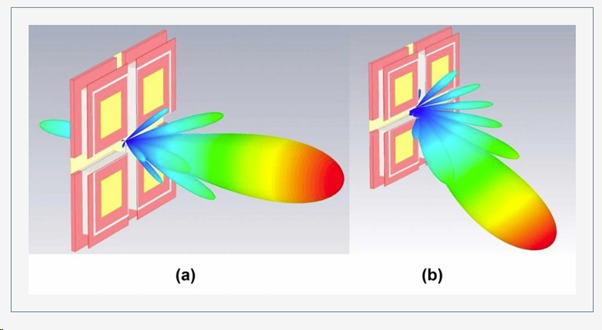
Figure 1: Beam steering manipulates the direction of the main lobe of an antenna array
The high frequency RF conundrum
On a top-down basis, the industry is currently moving forward with a compromise on wavelength and frequency; the Non-Standalone (NSA) New Radio (NR) air interface continues to support 3G and 4G as well as 5G at sub-6GHz frequencies. However, the long-term goal for 5G communications is to use a combination of sub-6GHz and millimetre wavelength (mmWave) frequency spectra between, approximately 24GHz – 100GHz. The fundamental conundrum for radio designers is that as frequency rises, wavelengths shorten. This poses challenges, especially for antenna design.
One obvious consequence is that mobile carriers need more base stations, closer to their end users. But even with plenty of base stations, signal propagation can be a problem. mmWave frequencies travel only short distances - say a few hundred meters or a kilometre at best - before they attenuate due to absorption loss associated with atmosphere, weather conditions, building materials and foliage, and other obstacles. The human body can also contribute to losses.
Accordingly, 5G deployments involve trade-offs. Higher mmWave frequencies support increased data throughput, but signal propagation becomes vulnerable. Phenomena encountered by engineers include: multipath (communications break-up); path loss; and packet loss. As a result, there is an urgent need for a proliferating variety of new base-stations and small cells – including femto, macro, nano, and pico cells.
The essential core component of these base-stations and cells is an antenna array, comprising multiple antennas, for both reception and transmission. This technique, which is not new, is known as MIMO (Multiple Input, Multiple Output).
MIMO is a response to how a signal breaks up into multiple paths, typically when it enters a building and tries to navigate through doors, windows, elevator shafts and other obstacles, creating signal reflections in the process. MIMO solves this multipath issue by using multiple antennas to maintain coherent data transmission. On a large scale, this is called “Massive MIMO”. Molex expects sub-6GHz communications to utilize 4 x 4 MIMO, and mmWave 5G to use 2 x 2 MIMO.
Traditionally, radio waves propagate rather like a stone dropped into water. If the antenna is the stone, by analogy, normally the radio waves will spread out as ripples in a circular fashion.
In the case of mmWave 5G, though, the higher frequencies introduce a high degree of directionality to RF propagation. Accordingly, antenna design becomes all-important to benefit from this near ‘line-of-sight’ propagation whenever possible. MIMO, in fact, when applied in really clever antenna designs, can not only mitigate multipath, but also possibly use “massive MIMO” techniques for ‘beam forming’ and ‘beam steering’, turning directionality to the advantage of the user – see Fig.1.
Beam forming allows signal propagation in very narrow paths; beam steering techniques ensure that mmWave signals can find a low-attenuation path towards the desired User Equipment (UE) location. Additionally, beam tracking is used to shift these directed beams as user equipment like mobile phones change positions as users move.
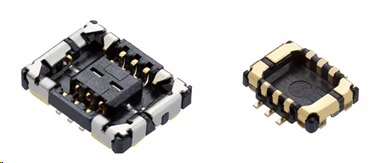
Figure 2: 5G mmWave RF flex-to-board connectors (Source)
Signal integrity and interference
While excellent antenna design is critical, as shown above, there are many further challenges; when dealing with weak signals, every fraction of a dB counts. The feeds, traces, and connections that go into the antenna must all be designed with high end-to-end signal integrity (SI) in mind. Molex 5G mmWave RF Flex-to-Board connectors are one example of the type of components needed – See Fig.2. They offer excellent signal integrity performance for high-speed, extreme RF applications, along with the robust mating features and PCB real-estate space savings needed in compact 5G mobile and other communication devices.
The challenge is compounded because mmWave signals are only one of many RF signals found within a typical 5G device. Firstly, the 5G spectrum includes sub-6 GHz frequencies in addition to mmWave. Sub-6 GHz signals are more familiar to cellular equipment designers, and they readily coexist with LTE technologies. However, their mere presence means that designers must deal with a broader spectrum than before.
Additionally, 5G devices are typically packed with many other RF technologies including Wi-Fi, Bluetooth, UWB, and NFC. Any leakage from the mmWave system can potentially affect the other frequency bands. Given that higher-frequency signals are inherently more prone to leakage, this risk should not be underestimated.
However, component solutions are available to mitigate the design effort and space constraints involved with accommodating multiple technologies. For example, Fig. 3 shows some Molex combo antennas, which offer expanded frequency ranges to handle a combination of multiple wireless communication protocols, while also delivering long-range connectivity, high-power efficiency, a compact form factor and easy integration. Combo GPS/Cellular and Combo Wi-Fi/GNSS antennas are available.
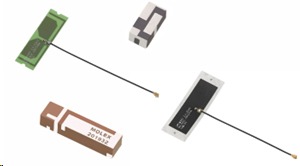
Figure 3: Combo antennas
Implications across the 5G network – for cells and user devices
Designing 5G networks has implications for both the cells and the user devices:
Cell sites: In addition to the increase in data and speeds anticipated by 5G, small cell sites are being designed to use even less power than the current 4G infrastructure does. 5G cell sites are expected to reduce the amount of always-on signal transmissions common in lower-frequency connections. This will allow 5G cells to switch to 'sleep mode,' potentially reducing energy consumption by up to 10 times compared with current idle systems.
Similarly, the use of multiple input, multiple output (MIMO) architecture — which allows 5G carriers to precisely point the signal from the cell site to the intended receiver — results in an optimal signal for the receiver (rather than transmission at high power in all directions). As a result, less energy is transmitted for each receiver, and the cell site can transmit to other receivers in various directions at the same frequencies, allowing for unprecedented flexibility.
User devices: The evolution in network infrastructure is just one side of the 5G deployment. Device manufacturers must prepare now to leverage the benefits of 5G by defining optimal RF device designs, regardless of the network structure. As with the cell sites, these designs will have to implement a completely different — and more complex — approach.
Since it involves a higher frequency, mmWave deployment requires chipsets for mobile devices to include all the key RF components on the same integrated circuit, including antennas. On the interconnect side, tolerances on mmWave connectors must be precisely tuned.
Device manufacturers will have to decide what parts of the 5G network they want each device to use. Existing RF electronics and antennas will suffice for simple, low-bandwidth devices, such as many IoT products. However, high-performance smartphones and 5G access routers will be best supported by using existing lower frequencies (sub-6 GHz) or optimized RF electronics for mmWave (>30 GHz) and additional mmWave antennas.
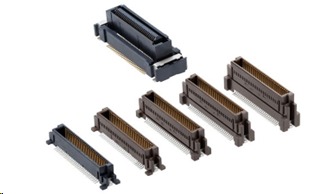
Figure 4: SlimStack Board-to-Board Connectors, 0.635mm Pitch, floating series, feature a best-in-class floating connector range with various circuit sizes and stacking heights while offering space savings, design flexibility and a simplified assembly process
More detailed design considerations
- Antenna placement and tailored design optimise the radiation patterns of mobile devices: The quality of RF performance with 5G antennas placed on or near the printed circuit board depends on how well the antenna is integrated into the product. However, at 5G’s relatively lower frequency sub-6 GHz bands, antenna placement is only part of the performance equation. There is a strong relationship between the antenna and the mobile device’s internal configuration in determining the overall resonance performance of that device’s wireless communications. Given user preference for thin mobile devices, antenna engineers have needed to consider the physical design, material selections, and internal component configurations when tuning the antenna design.
At mmWave frequencies, though, the interaction between the antenna and the phone body is of less concern. Instead, the challenge is that the covering over the antenna, be it metal, glass, or even plastic is no longer electrically thin and can have negative impacts on the radiating performance of the underlying antenna. Also, the placement of the antenna with respect to the device user’s hand will influence mmWave transmission and reception.
Here design engineers are looking at how to couple tailored antenna design and unique antenna placement along with slot-based design or frequency selective surface design principles which can be employed successfully to optimise the radiation patterns of mobile devices antennas. Additionally, the use of multiple antennas on a user device is required to overcome beam propagation loss in non-ideal directions.
- Antenna-tuning techniques improve transmitted power efficiency and, therefore, battery life: Device manufacturers have increasingly turned to the skills and experience of radio frequency engineers, seeking out best RF design practices for optimally tuning the antenna to each device to enhance wireless performance. Antenna-tuning techniques include aperture tuning – where the electrical length of the antenna is calibrated to match its resonance more closely to the required frequency band, and impedance tuning – where the impedance of the antenna is correlated with the RF frontend.
Both techniques can improve gain over a wider bandwidth and improve battery life, as a tuned antenna draws less current than an untuned antenna to deliver the same amount of transmitted power. This is a crucial factor when it comes to meeting consumer expectations around the performance of next generation 5G mobile phones.
- Highly designed connectors protect against unwanted signals, maintain signal integrity and shield against Electromagnetic Interference (EMI): High frequency 5G signals also introduce further considerations around interconnections, board traces, cable assemblies, and connectors. Sending millions of bits across a series of components at speeds dictated by 5G standards inside consumer-grade products presents significant challenges.
Connectors must be carefully designed and manufactured to minimise any impedance variations along the transmission line. External signals can also pose a threat. Therefore, connectors must sufficiently protect the system from electromagnetic interference and capacitive pickup, which becomes increasingly difficult at higher speeds.
5G connectors must also fit into the tiny spaces afforded by modern mobile devices. Stacked connectors allow for densely populated flexible and rigid circuit boards – see Fig.4. Despite the stringent physical constraints, 5G electronics must still meet demanding requirements for scattering parameters, such as voltage standing wave ratio and insertion loss. Well-designed connectors can minimize reflections, degradation, and distortion of the signal while reducing physical footprint, and can be adequately shielded to effectively cut down on EMI.
- Transmission line effects: In addition to managing the challenges of the air interface and associated antennas, extremely high-frequency 5G signals also introduce further challenges for monolithic microwave integrated circuits (MMICs), chip-to-package interconnections, board traces, cable assemblies and connectors. Propagation of signals at gigahertz frequencies causes cables and traces to behave as transmission lines rather than simple wires. The current and voltage vary in magnitude and phase over the length of a transmission line.
Transmission lines can introduce difficult-to-troubleshoot errors if not handled correctly during design. If trace lengths are longer than one-fourth of the signal wavelength, the transmission-line effects must be considered during design. Additionally, at those lengths, there are antenna effects that could have impacts, such as electromagnetic interference and crosstalk; designers must also allow for these.
Connectors can also introduce challenges to achieving an effective and efficient mmWave-based system. Component designers must contend with requirements that constrain the geometry, size and material selection of connectors while still having to match the characteristic impedance of the entire transmission line. Impedance matching is crucial to reducing signal reflection and achieving maximum power transfer. This, in turn, maximises the amount of energy radiated by the antenna to generate the strongest wireless signal possible for the receivers.
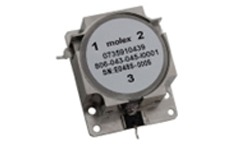
Figure 5: Isolators & circulators
In such situations, inserting devices into a transmission line can cause insertion loss, which means a loss of signal power. If the power transmitted to the load before insertion is PT and the power received by the load after insertion is PR, then the insertion loss in decibels is given by IL(dB) = 10 log10 PT/PR
It is very challenging to meet required specifications such as those pertaining to insertion loss, return loss, power, IMD (passive intermodulation) and temperature stability in a small isolator and circulator package. However, by combining their experience with their patented technologies, Molex can provide isolators and circulators as small as 6mm while meeting customer requirements, in high production volumes – See Fig.5.
Power handling is very dependent on the circulator’s mechanical design and ferrite material properties. Using high power increases temperature and, therefore, degrades performance. Molex engineers select raw materials with appropriate properties, including the required operating temperature range.
Low IMD is very important in systems and is not easily achieved in smaller devices. It usually requires larger isolators and circulators and thicker dimensions. Proper design through applying Molex expertise, along with optimised materials and dimensions selection, results in acceptable IMD and harmonics performance with frequency bandwidth suitable for meeting customer expectations.
5G connectors must also be able to handle significantly higher power than previous generations (15A+ instantaneous current draw is possible in certain situations). Molex PowerWize high-voltage, high-current wire-to-board/wire-to-busbar connectors – see Fig.6 - are offered in two sizes, 6.00 mm and 8.00 mm, suitable for applications requiring up to 1,000 V and 190 A. Additionally, the headers can be mounted on either printed circuit boards or busbars.
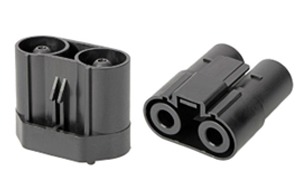
Figure 6: PowerWize high-voltage, high-current connectors
Conclusion
The challenge for design engineers is to create new 5G products which are suitable for mass production while meeting customer expectations. This means selecting the most appropriate 5G components and correctly incorporating them into highly sensitive environments, while also ensuring accurate testing.
Molex is highly invested in 5G research and development, providing a broad range of optical, copper, RF connectivity, antenna, networking, testing, and computing solutions. Through investment in state-of-the-art manufacturing equipment and new higher frequency RF test chambers, Molex enables the development of cost-effective, best-in-class products that help their customers bring 5G ideas and technology to market, faster. Explore more about Molex Wireless Infrastructure Solutions & Technology, click here.






Technologies
Technologies


Artificial Intelligence
One of the greatest revolutions in all of human history! AI is an all-encompassing concept that incorporates human intelligence into machines
DEVKIT HQ
The #1 Destination for Embedded Evaluation Boards, Development Kits, and Tools
IoT Sensor to Cloud Platform
/IOTCONNECT™ accelerate your loT journey with secure, ready-to-use cloud connectivity
Further Resources
Calculators & Conversion Charts
Selection Guides and Catalogues
Essential Learning Modules
Tech Spotlights
Design Resources
Engineering Glossary
Technical Support
Parts Finder Tools